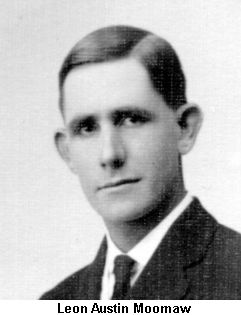
Photo courtesy of Russell Scott Moomaw & Robert Austin Moomaw
Data source is the 1990 book, "Moomaw-Mumma-Mumaw-Mumaugh Genealogy" compiled by Robert Austin Moomaw (deceased).
HISTORY OF WESTERN NEBRASKA AND ITS PEOPLE 1921 Vol III
GRANT L. SHUMWAY - EDITOR-IN-CHIEF
BIOGRAPHICAL SKETCHES p. 143
[
http://www.usgennet.org/usa/ne/topic/resources/OLLibrary/hwnep/voliii/hwnartdx.htm]
-----------------------------------------------------
LEON A MOOMAW, Cotner Uni. A.B. A.M.--Although entitled to place after his name letters indicating hard won college degrees, it may be possible that Professor Leon A. Moomaw, of Morrill county, takes equal pride in the success that has attended his agricultural undertakings. Born and reared on a farm, the memory of Nature's ever recurring miracle of seasons and plenteousness rewarding honest toil, may have accompanied him through university life and subsequent intellectual effort in the educational field, for the time came when college honors were laid aside and the learned teacher became an enthusiastic farmer. Remembering that agricultural production is the basis of all production, the transfer of scientific knowledge from the professions to the fields must, with such earnest men as Mr. Moomaw result beneficially.
Leon A. Moomaw is a native of Nebraska, born in Scottsbluff county, December 27, 1887, and is a son of Austin and Agnes (Spriggs) Moomaw. The father was born in Illinois, fifty-seven years ago, and the mother was born in Missouri. In 1886 they came to Nebraska and homesteaded in Scottsbluff county, where the father has ever since been a general farmer. Later he secured a tree claim in Morrill county. Until he was twenty-two years old, Leon A. Moomaw resided on his father's farm, but in the meanwhile his education was attended to and from the local schools he entered Cotner at Lincoln, from which he was graduated with the degree of A. B. Later he entered the State University at Lincoln, from which he bore off the degree of A. M. He then entered the educational field, in no subordinate position, however, but as a member of the faculty of Cotner University, in which institution he was professor of history for three years.
In 1914 he was united in marriage to Miss Minnie E. Young, who was born in South Dakota, July 25, 1886. Her parents, Hiram and Sarah (Adams) Young, lived in Iowa. Since 1909 they have lived retired at Lincoln, Nebraska. Mr. and Mrs. Moomaw have two children: Evelyn and Robert. In 1912 both Mr. and Mrs. Moomaw homesteaded in Banner county and they are still holding their 1,180 acres of dry land there, the subsequent development of which may be stupendous. In 1913 they came to Morrill county and he took charge of his father's old tree claim, has 200 acres, and has devoted his best efforts to the development of this land ever since. All the land is now irrigated and under Mr. Moomaw's intelligent management is a wonderfully productive property. He has placed fine improvements here and has one of the spaciouse (sic) modern homes of this section. Both he and wife are members of the Christian church, and they have a wide social circle. Although not active politically, Mr. Moomaw is not an indifferent citizen, but on the other hand, every movement that promises to be of substantial and permanent benefit to the county, finds in him an earnest advocate.
+++++++++++++++++++++++++++++
Funeral services for Leon Moomaw, 87, pioneer of the Bayard area, will be held today in the Church of Christ in Bayard with the Rev. Olin Atwood officiating and burial in the Bayard cemetery. The Plummer Towne Funeral Home is in charge of arrangements. A memorial has been established by the Platte Valley Bible college.
He was an author and co-founder of the Platte Valley Bible college. He was born Dec. 27, 1887 in Scotts Bluff County and was a graduate of Cotner university at Lincoln and received his Masters from the University of Nebraska. After receiving his Masters, Moomaw lectured in many colleges in a five state area for the Intercollegiate Prohibition Association. He returned to Cotner university where he became the head of the department of American History and Social Science.
He was the author of four books: "The History of Cotner University," "Pioneering in the Shadow of Chimney Rock," "My Piece of the Prairie" and the "History of the Christian Churches and the Platte Valley Bible College."
He homesteaded the land north of Bayard at the junction of U. S. 26 and L62A in 1916. The corner has been known as the Moomaw Corner since that time. At different times he operated a truck farm, general store, bean elevator, potato warehouse and auction house from this location.
He taught at the Platte Valley Bible college and served as the president of the college executive committee. He was director of the Rural Electric Association for 35 years, served on the Morrill County Extension Board, was an officer of the District 4 School Board, was associated with the development of the valley's irrigation systems and was associated with the organization of the Chimney Rock Public Power District. He was a past honorary president of Oregon Trail Days.
Survivors include his wife, Minnie; sons, Robert of Houston, Tex., Russell of Wayne; daughter, Mrs Phyllis Sears of Lincoln; sister, Mrs. Vera Walford of San Antionio, Tex; seven grandchildren and seven great grandchildren. He was preced in death by a daughter.
+++++++++++++++++++++++++++++++
[The following article was written by Leon A. Moomaw in 1967 and transcribed from the original handwritten document by Robert A. Moomaw on January 3, 2007]
LEROY MOOMAW
One mid-afternoon in August our telephone rang. In answering, a man said "this is Leroy Moomaw. I am at the library. Could I see you for a short while." I responded, stay right there and I will come down and get you. We recalled having visited his family in their Missouri home about 10 years ago. We were always almost startled when hearing anyone with the name "Moomaw" since it was so rarely heard. However in this case we knew it to be a distant relative. We brought him to our home and persuaded him to stay overnight with us.
That evening my wife and I visited with him and showed him some family pictures. We learned his life story. He began as an agronomist doing work in the northwest part of the United States before coming to the Experiment station at Dickinson, North Dakota in 1919, where he stayed for 31 years especially working with the development of pasture grasses. Upon leaving, they moved to southwestern Missouri mainly because this had been the childhood home of his wife. Her family had started a large dairy operation. This was a beautiful country well adapted for such a venture. With the very best of cows and modern equipment, it became a successful business. His youngest son helped him one year making valuable improvement but decided he wanted to do different work.
As we visited that evening, we found him to be a highly educated man capable of discussing most any subject. His wife had passed away two years before. He had sold the dairy and all of his land. The three sons had each received a good education and are efficient in their lines of work. Each has a home and family of his own.
When we asked for his address he spoke rather sadly "I really don't have a home or any permanent address." We asked what was his mission on this trip. He responded, "I am all alone. I am growing older but still physically able to do some work. I feel like I should continue to do something worthwhile. For years, I have been interested in crested wheat grass, having begun experimental work in 1915. I am now visiting Experiment stations to find out what work they have done. I go to universities and libraries to see what material they have. I want to get their estimate of its value and its power of resistance to dry weather. I want to meet people who have grown crested wheat for pasture and get their opinion, and wish to contact seed dealers to get their ideas of value as reported by growers. He had been almost a month on this trip visiting in western Kansas, eastern Colorado, western Nebraska and Wyoming. He wanted in the future to go to Utah, Arizona and New Mexico but was then on his way to North and South Dakota.
The next morning it seemed to me it was with reluctance he prepared to leave. We had talked of our kinship which had perhaps created a closer tie. As I saw him drive away my mind was filled with many thoughts. Here was a man grown older having given his life in distinguished service for the development of agriculture. The death of his wife had deprived him of home and companionship. He had developed a splendid business but none of his sons wanted it, which forced him to sell everything. He was far beyond retirement age and could spend the rest of his time in leisure but no, the call to service, the urge of duty kept him pushing on toward the sunset. How different from many who are demanding more leisure, longer vacations, and above all less work and responsibility.